

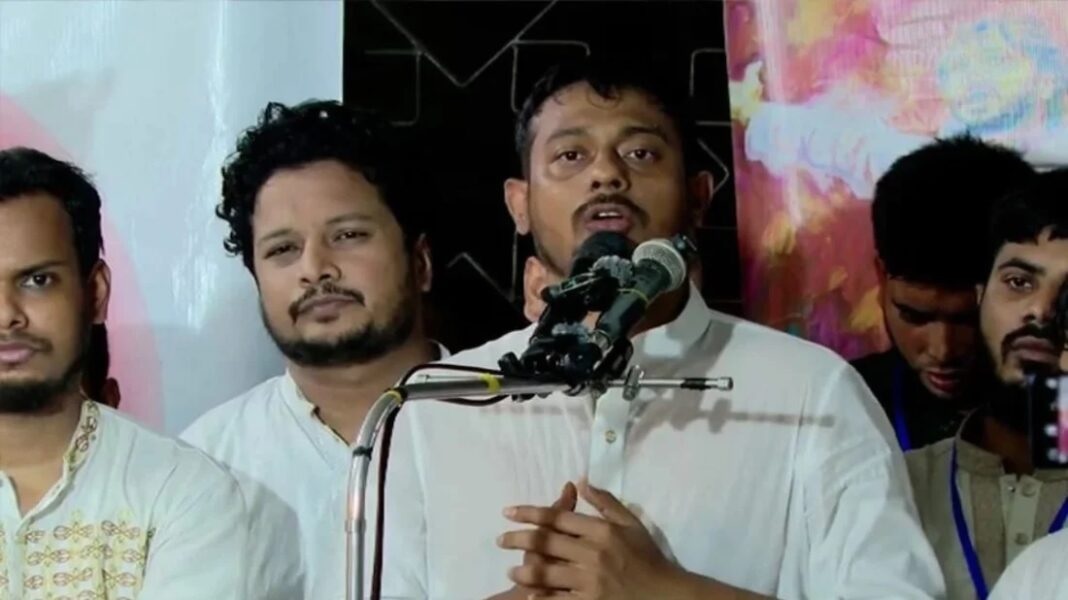

Nasiruddin Patwari speaking. File photo.
We do not want dominance, we do not want conflict, said National Citizens Party (NCP) chief coordinator Nasiruddin Patwari. He said, we want friendship of equality, mutual respect and fair neighborly relations. The future of India-Bangladesh relations should not be “elder brother-younger brother”, but a relationship of equal dignity between two sovereign neighbors.
He made this comment in a post on his verified Facebook ID on Sunday (October 4).
Nasiruddin Patwari wrote in the post that Indian High Commissioner to Dhaka Dinesh Trivedi said that India had no other option but to grant asylum to Sheikh Hasina in India in August 2024. He also explained this as India’s responsibility as a neighbor. But an important question remained tactfully unspoken in his statement, not only the decision to grant asylum to Sheikh Hasina, but also India’s role in shaping the political reality of Bangladesh over the past decade?
The NCP leader said that an investigation by the UN Human Rights Office has revealed a horrifying picture of the horrific repression that took place against the people of Bangladesh in July-August 2024. According to the UN, around 1,400 people may have been killed between July 1 and August 15, and security forces used widespread lethal force.
Referring to the long-standing question of the people of Bangladesh regarding India’s close relationship with the regime of Sheikh Hasina’s government, he said, “As a result, when India today explains its position as only a “neighbor’s responsibility,” the natural question of the people of Bangladesh is, is the responsibility of a neighbor only to shelter a deposed ruler, or to also respect the democratic aspirations, dignity and sovereignty of the people of the neighboring country? There is no room for avoiding another reality: borders.”
Stating that the loss of lives on the India-Bangladesh border has not stopped yet, the NCP leader said that according to the Ain O Salish Kendra, 34 Bangladeshis were killed by Indian border guards in 2025; in the first six months of 2026, 10 Bangladeshis were killed and 10 injured in 21 border violence incidents. Even in 2026, Human Rights Watch has documented allegations against various Indian authorities of pushing Bengali residents into Bangladesh without due legal process. According to them, since early June, Bangladeshi border guards have thwarted 21 attempts to push more than 200 people towards the border.
He said, “However, India and Bangladesh’s own official documents state that civilian casualties on the border are a matter of concern and that the border guards of both countries must take measures to reduce such incidents to zero. Then the question arises: If we talk about the responsibility of neighbors, why doesn’t that responsibility apply equally to protecting the life of an unarmed person on the border?”
Stating that Bangladesh does not want to become an anti-India state, Nasiruddin said, “We want India-Bangladesh relations to be based on equality, friendship, trade, communication, cultural relations; but its foundation should be mutual respect, sovereign equality and fair interests. India should see the people of Bangladesh not as part of any larger geopolitical imagination, but as the people of an independent and sovereign nation. Any expansionist or hegemonic political imagination like “Akhand Bharat” is not acceptable to the people of Bangladesh.”
In the post, he also mentioned that respect for each country in South Asia’s own history, culture, territory, and national identity can be the basis for sustainable neighborly relations.
The NCP leader said that Bangladesh’s fair share of the river, security of people on the border, balance in trade, human rights in border management, and undue influence on Bangladesh’s internal political affairs should be resolved through negotiations on the basis of equality, not through pressure. The Ganga Water Treaty is also due to expire in December 2026, and Bangladesh has already offered to renegotiate. It is time for India to understand one thing clearly: Bangladesh is not a subordinate territory, not a “backyard” and not part of a larger state imagination.
Noting that Bangladesh is an independent state, he said, if India really talks about its responsibility to its neighbor, then the first condition of that responsibility should be full respect for the sovereign decision of the people of Bangladesh, their national dignity, their own culture and territory.