

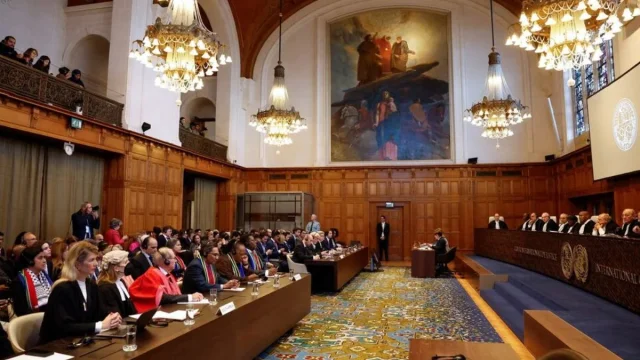

Judges at a hearing before the delivery of a ruling in the genocide case brought by The Gambia against Myanmar at the International Court of Justice in The Hague, Netherlands. Photo: AFP
Following the International Court of Justice (ICJ) ruling that found Myanmar responsible for committing genocide against the Rohingya people, the United Kingdom has imposed sanctions on five of the country’s top military officials. This marks the first time the UK has taken punitive action against Myanmar following a judgment by the UN’s highest court holding a state accountable for committing genocide.
The five military officials subject to the sanctions are Myo Htut Hlaing, Myo Min Tun, Myat Thet Oo, Kyaw Swe, and Kyaw Swar Oo. Several countries—including Australia, Belgium, Portugal, Spain, and Canada—have aligned themselves with the United Kingdom in supporting the ruling of the International Court of Justice (ICJ).
UK Foreign Secretary Ed Miliband stated, “Our response to heinous crimes like genocide must reflect our own values, while also ensuring that effective action is taken.”
Thousands of Rohingya lost their lives during the crackdown carried out by the Myanmar military in 2017. More than 700,000 Rohingya fled to Bangladesh to save their lives. The British Foreign Secretary noted that there are currently over 1.2 million Rohingya refugees residing in Bangladesh.
According to Miliband, the current president, Min Aung Hlaing, was in command of the Myanmar military during the atrocities committed against the Rohingya in 2017. He bears direct responsibility for the crimes committed at that time. The United Kingdom imposed sanctions on him as early as 2021.
The British Foreign Secretary also called for an end to the ongoing human rights violations in Myanmar. He stated, “Myanmar must put an end to the ongoing human rights violations. Those responsible must be investigated, prosecuted, and held accountable. At the same time, steps must be taken to ensure that such atrocities do not occur again in the future.”
Furthermore, he announced plans to introduce new legislation aimed at halting the supply of aviation fuel to Myanmar. Following the ICJ ruling, the UK also expelled Myanmar’s defense attaché.
In his address to the British Parliament, Miliband stated that the United Kingdom intends to raise the matter of the ICJ ruling at the UN Security Council this week. There are also plans to convene a separate meeting on this issue within the next two weeks.
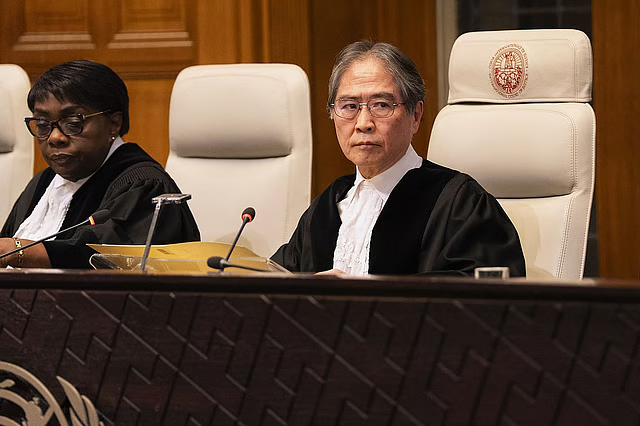
President of the International Court of Justice, Judge Iwasawa Yuji, delivered the ruling in the case concerning allegations of genocide against Myanmar.
ICJ Ruling and Allegations of Genocide
On November 19, the International Court of Justice (ICJ) delivered its ruling in the case concerning the genocide of the Rohingya people by Myanmar. The court observed that, upon reviewing the evidence presented, there is no reasonable conclusion to be reached other than that there was an intent to commit genocide. The ruling was adopted by a 9–6 vote by the court’s panel of judges, who hail from various nations around the world. Furthermore, Myanmar was held responsible for violating several provisions of the 1948 Genocide Convention.
The ruling highlights that approximately 10,000 Rohingya were killed during the “clearance operations” conducted by the Myanmar military in Rakhine State—which borders Bangladesh—in 2017. Various reports have documented crimes committed during these operations, including the burning of Rohingya homes and entire villages, as well as sexual violence, torture, and the killing of women and girls. Myanmar authorities, however, have consistently denied these allegations.
At that time, Aung San Suu Kyi held the position of the country’s civilian leader. She was subsequently ousted from power in a military coup in 2021.
Meanwhile, conflict persists in Myanmar. Members of the British Parliament have been informed that the country is experiencing airstrikes. At the same time, there are reports of violent activities by the Arakan Army. Consequently, the international community remains concerned not only about the Rohingya crisis but also about the overall security and human rights situation in the country.
Source: BBC