

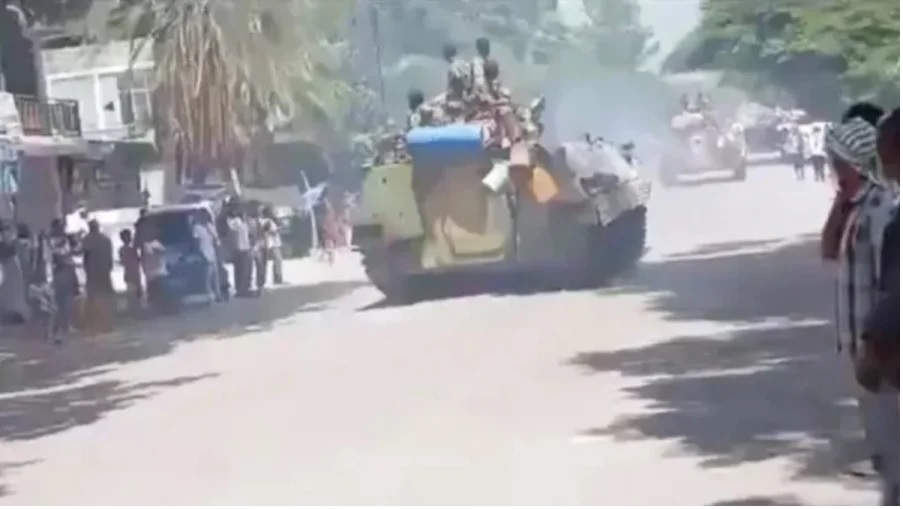

Tanks and armoured vehicles are seen moving through Almaty after days of clashes. Photo: BBC
At least 52 civilians have been killed in three days of intense fighting in and around the town of Alamata in Ethiopia’s northern Tigray region.
The BBC reported this information in a report citing hospital sources.
Government forces are believed to have taken control of the city of Alamata from regional fighters. They are now preparing to advance on Mekelle, the main city in Tigray. Videos circulating on social media show army tanks on the streets of Alamata.
Tensions had been simmering for months between the group controlling the Tigray region and the central government.
Last week, it escalated into clashes, with both sides blaming each other for breaking a deal that ended a two-year civil war in 2022. The conflict has also spilled over into surrounding areas. Thirty-three tourists have been stranded in the UNESCO World Heritage site of Lalibela for the past week.
A British tourist in Lalibela told the BBC that they had heard fighting, gunfire and heavy artillery fire for the whole week. He also said there was a large military presence in the town. Lalibela is famous for its 13 churches carved out of rock in the 13th century. The town is an important holy site for Orthodox Christians.
Most tourists were unable to leave the town after the airport was closed to commercial flights on Wednesday.
However, 14 Israeli tourists were evacuated by military helicopter on Monday. The fighting around Lalibela involves government forces and a militia from the Amhara region. The militia is allied with Tigray fighters. In early September, they formed a seven-member coalition with several other armed groups. Their declared goal was to overthrow the government in the capital, Addis Ababa. There are fears that neighboring Eritrea could also be involved in the conflict. The Ethiopian government has accused Eritrea of supporting the armed groups. Eritrea denies the accusations.

The BBC has been unable to gather direct news from Tigray and surrounding areas. The communications blackout has made it difficult to know for sure what is happening there. There is also disagreement between the two sides over who started the recent fighting. The Tigray People’s Liberation Front (TPLF) says it has carried out a counter-attack in response to the central government’s attacks. It claims drones were also used in the attack.
On the other hand, the Ethiopian government says that the Tigray forces launched the attack first. They claim that the Tigray forces began the attack after taking control of the airports. TPLF fighters are also fighting in various areas, including the Afar region. Afar is strategically important for Ethiopia. This region connects landlocked Ethiopia to Djibouti and the country’s ports.
The international charity Médecins Sans Frontières (MSF) said more than 700 wounded people had been admitted to hospitals it supports in Tigray in the past few days. A doctor at Alamata General Hospital told the BBC that fighting had broken out in the city and surrounding areas from Saturday to Monday, using heavy explosives and artillery. Some of the attacks had damaged residential buildings. The dead included babies as young as three days old. Women and herders were also among the dead. The doctor said 12 people were killed in an attack on a market in the city.
The government has cut off banking services in Tigray since the fighting began. Internet connections have also been cut off. It is not clear who ordered the shutdown. A source in Alamata told the BBC that the humanitarian situation there is rapidly deteriorating. The city is now overcrowded with people fleeing the fighting. The person said people from surrounding areas are walking to Alamata, some walking for up to an hour. They thought the city would be safe. But banking services, money transfers, electricity, internet and phones are all out of service in the city. As a result, people are facing major problems.
A British tourist in Lalibela said that although online banking is available there, there is a cash shortage. He said that the situation in Lalibela has calmed down somewhat in the past two days. However, the airport is still being used by the military. There are some indications that the airport may reopen on Thursday. He added that local people are still in a state of fear and anxiety. There is a military presence in the city and a large military contingent has been seen moving north.
There were 53 tourists in Lalibela when the airport was closed. Some have since been evacuated. Fourteen Israeli tourists were airlifted on Monday. Five more left the city the day before in a private convoy. The largest group of tourists still stranded in Lalibela are US citizens. There are also citizens of Israel, the UK, South Korea and South Africa. Dual citizens of Ethiopia and New Zealand and a Mexican national are also stranded there.
The Addis Ababa-based Tigray Broadcasting Service (TBS) has taken an initiative to communicate with people stranded in Tigray due to telecommunications shutdowns.
The television channel said it will receive video messages from people outside Tigray via Telegram channels. The messages will then be broadcast on satellite television. These messages can include greetings and the latest news. This could be an important opportunity to stay in touch with families amid the lockdown. Meanwhile, government restrictions on banking services in Tigray have also affected Tigrayans outside the region.
Several customers told the BBC that their bank accounts in Tigray had been closed or restricted. A former resident of Tigray said he moved to the capital two months ago as tensions rose. He recently ran into problems making payments on his mobile phone on his way from Addis Ababa to Adama. He told the BBC’s Tigrinya Service that the closure of banking services had created major problems for people like him who had fled Tigray. Many Tigrayans are now in danger.