

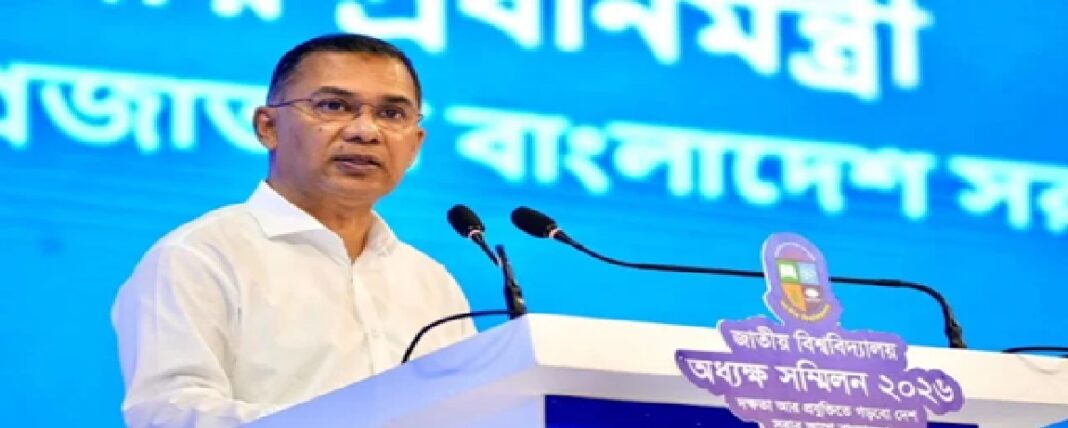

Prime Minister Tarique Rahman speaking at the National University Principals’ Conference 2026 at the Mirpur National Stadium. Photo: PMO
Prime Minister Tareq Rahman has called for a transformation of the conventional higher education framework to establish a system that is technology-driven, innovation-oriented, and conducive to employment. To this end, he has emphasized enhancing students’ practical and technical skills, strengthening ties between educational institutions and the industrial sector, expanding internship and apprenticeship programs, and creating opportunities for learning multiple languages.
He made these remarks while speaking as the chief guest at the National University Principals’ Conference 2026, held on Saturday (November 28) at the Mirpur National Stadium. Principals from over 2,300 colleges affiliated with the National University participated in the conference.
The Prime Minister stated that unemployment cannot be reduced merely by increasing the number of educated individuals who hold only academic certificates. Acquired knowledge must be transformed into skills relevant to the workplace. In this regard, establishing an effective connection between educational institutions, industries, and students is essential.
Highlighting the significance of the role of principals, Tareq Rahman noted that the responsibilities of a college principal extend beyond the management of administrative affairs. A principal provides leadership, offers moral guidance, and serves as the primary driving force behind academic activities. The competence, wisdom, decision-making capacity, and foresight of principals play a crucial role in shaping the future of the new generation.
He stated that former Prime Minister Khaleda Zia established the National University on October 21, 1992, with the aim of expanding higher education opportunities for people in both urban and rural areas. Currently, the university has approximately 2,500 affiliated colleges. However, despite the increase in the number of institutions and students, the question remains as to whether the quality of education has reached the expected standard.
He noted that, much like other sectors in the country, the education system suffered during the era of fascist rule. Now, in a Bangladesh free from fascism, the education system must be rebuilt through a collective effort. The government is currently working on plans and initiatives to modernize the system and align it with contemporary demands. However, college principals must take the lead in implementing these changes.
**Teacher Training and Technology-Driven Education**
He emphasized the importance of training to equip teachers with the skills needed to keep pace with rapid technological advancements. In his view, it is essential to shift away from traditional, teacher-centric instruction toward student-centered and research-based pedagogical methods. In this regard, “train-the-trainer” programs could play an effective role.
He warned that if teachers and students fail to adapt to modern, technology-driven education, the number of degree holders will continue to rise each year, yet the unemployment situation will not improve. A lack of practical and technical skills—alongside academic knowledge—is a primary reason for unemployment among the educated population.
Highlighting the context of the Fourth Industrial Revolution, Tarique Rahman pointed out that while half the world’s population has yet to fully benefit from the Third Industrial Revolution, the globe has already entered the era of the Fourth Industrial Revolution. Consequently, higher education institutions must move beyond outdated educational paradigms and embrace technology, innovation, and skill-based, career-oriented education.
He noted that innovations such as artificial intelligence, robotics, big data, the Internet of Things (IoT), blockchain, automation, genetic engineering, biotechnology, cybersecurity, and fifth-generation (5G) wireless technology are driving significant transformations in the future workplace. These technologies are reducing the demand for certain traditional professions, while simultaneously creating new employment opportunities.
In the Prime Minister’s words, education empowers individuals, and a clear goal directs that power toward success. Education without a goal is like a journey without a destination. Therefore, knowledge acquired through education must be translated into the skills required for professional life. To achieve this, collaboration between industrial and educational institutions—‘industry-academia collaboration’—is essential.
Over 1,500 Memorandums of Understanding (MoUs) with Industrial Organizations
Explaining the need for synergy between the education and industrial sectors, the Prime Minister stated that educational institutions should build the foundation of knowledge, while industrial organizations should provide the opportunity to transform that knowledge into practical, job-ready skills. Through this, students will evolve into future innovators, entrepreneurs, and partners in economic progress. Classrooms will serve as hubs for knowledge and innovation, laboratories as spaces for exploring new possibilities, and industrial organizations as effective centers for hands-on learning.
She noted that the government has taken initiatives to align higher education with the demands of the job market by promoting apprenticeship programs, internships, and industry-academia collaboration. In recent months, the signing of over 1,500 Memorandums of Understanding (MoUs) between various universities and industrial organizations has been finalized.
She highlighted the presence of entrepreneurs and representatives from employer organizations at the principals’ conference as a tangible reflection of these initiatives. The Prime Minister urged colleges and universities to develop into centers for innovation, entrepreneurship, technological advancement, and new business ventures.
To this end, she called upon principals and vice-chancellors to seriously consider inviting experienced and skilled professionals from the industrial sector to serve as guest faculty in colleges and universities. Simultaneously, she encouraged entrepreneurs to come forward and facilitate internships, industrial attachments, and hands-on training for students within real-world professional environments. Tareq Rahman stated that if students are provided with opportunities to acquire practical skills and experience aligned with their goals during their academic life, they will not have to simply wait for a job upon graduation. Instead, they will be able to launch their own businesses or ventures, thereby creating employment opportunities for others.
Emphasis on Multilingual Education and Career Counseling
Alongside technical and professional skills, the Prime Minister emphasized the importance of fostering humanistic knowledge and values among students. She noted that an education system oriented toward practical work—grounded in strong ethics—must be developed; however, the purpose of education should not be limited solely to job preparation.
She advocated for the cultivation of humanistic values, creativity, logical reasoning, and leadership qualities in students through the study of literature, philosophy, history, science, sociology, and culture.
The Prime Minister further remarked that to fully realize the benefits of educational planning and initiatives, opportunities for learning multiple languages must be expanded. In addition to English, which is essential for international communication, provisions should be made for students to learn other globally in-demand languages, such as Arabic, Mandarin, Japanese, Korean, French, German, and Italian.
She called for the further expansion of career counseling, internships, skill development programs, language clubs, and entrepreneurship-building initiatives across all colleges affiliated with the National University.