

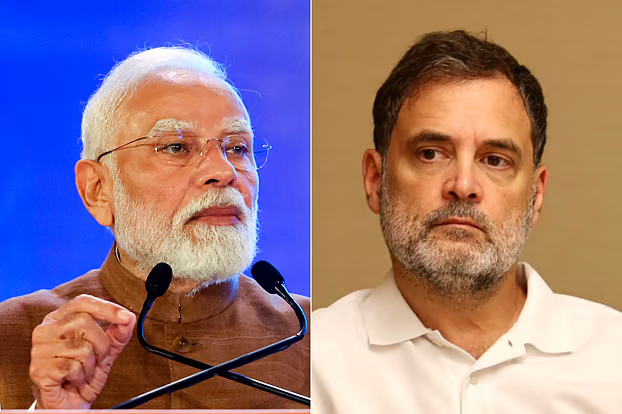

Indian Prime Minister Narendra Modi and Congress leader Rahul Gandhi. File photo: ANI
Narendra Modi’s government is determined to accomplish what proved impossible seven months ago. A special session of Parliament is set to begin next Monday. Within four days, the government aims to pass a constitutional amendment bill in both houses—the Lok Sabha and the Rajya Sabha—to increase the number of parliamentary and assembly seats, which will necessitate a redrawing of electoral constituencies. The bill is scheduled to be introduced in the Lok Sabha on Monday and Tuesday, followed by the Rajya Sabha over the next two days. For this purpose, Parliament has remained in session for 109 consecutive days, even after the conclusion of the monsoon session.
The current strength of the Lok Sabha, the lower house of the Indian Parliament, is 543. The number of elected representatives from each state is determined based on its population. The last such reallocation of seats took place 50 years ago. If this bill is passed, the number of Lok Sabha seats will increase to 850. One-third of these additional seats will be reserved for women. The government intends to implement this change starting with the 2029 Lok Sabha elections.
Seven months ago, in April, the government failed to pass these two bills. Passing a constitutional amendment bill requires the consent of two-thirds of the members. At that time, the bills were defeated due to opposition from the ‘INDIA’ alliance. This time, the BJP is determined to turn that past failure into success by creating a rift within the opposition ranks.
The political landscape has also shifted over these seven months. Last May, the DMK lost in Tamil Nadu, and the Trinamool Congress (TMC) faced defeat in West Bengal. A new party, TVK, formed the government in Tamil Nadu, with Joseph Vijay becoming the Chief Minister. To block the BJP, the Congress, the Indian Union Muslim League, and the Left parties extended their support to this new government—a move that infuriated DMK leader M. K. Stalin, leading him to withdraw from the ‘INDIA’ alliance.
In West Bengal, the BJP engineered a split within the Trinamool Congress’s parliamentary ranks; 20 of its Lok Sabha members defected to an obscure party called the NCPI. Having secured the support of the DMK’s 22 members and the 20 defecting TMC MPs, the BJP turned its attention toward the NCP—led by Maharashtra’s political strongman, Sharad Pawar. Last Friday, the NCP signaled that it would support the bills. The party currently holds 8 seats in the Lok Sabha.
Beyond merely supporting the bills, the NCP may leave the ‘INDIA’ alliance to join the BJP-led NDA at the Centre, as well as the ruling coalition in Maharashtra—comprising the BJP, the Ajit Pawar-led faction of the NCP, and the Shiv Sena. There is intense speculation that Sharad Pawar’s daughter, Supriya Sule, has been offered a ministerial position in the Union government. It is also rumored that if the NCP joins the state government, it could secure two full ministerial berths.
The bills introduced seven months ago did not explicitly state a 50 percent increase in parliamentary seats for all states. Stalin opposed the proposal because an increase in seats based on population would have diminished the representation of southern states relative to those in northern and western India.
At that time, at Stalin’s initiative, a conference of Chief Ministers from opposition-ruled states was convened to oppose the bills. A proposal was also adopted to keep the number of Lok Sabha seats unchanged for the next 30 years—a proposal that had previously been passed by the Legislative Assembly as well. However, Stalin has now shifted his stance. He argues that the state’s share in the Lok Sabha remains fixed at 7.18 percent. Furthermore, a provision for a 50 percent increase in the total number of seats is being included in writing, with the stipulation that this increase will remain unchanged for the next 25 years.
Having been cornered in state politics following a defeat in the Legislative Assembly elections and the emergence of TVK as a “third force,” Stalin has now leaned toward the BJP. While it remains unclear how much he stands to gain politically, it is widely believed that his party will no longer oppose the bill. Even if they do not explicitly vote in favor of it, they might assist the BJP by simply abstaining from the vote.
The last time Lok Sabha seats were increased was based on the 1971 census. The most recent national census took place in 2011; the 2021 census could not be conducted due to the COVID-19 pandemic, and the process is now set to begin from 2026. Although the Women’s Reservation Bill was passed, it was originally intended to take effect from the 2034 Lok Sabha elections—following the 2029 cycle. However, the BJP—having successfully expanded its influence across the Hindi heartland—is keen to retain power by implementing the seat increase and the women’s reservation quota as early as 2029, rather than waiting until 2034.
While the roles played by Stalin and Sharad Pawar, along with the fractures within the Trinamool Congress, have emboldened the BJP, they have left the INDIA alliance feeling deeply disheartened.
During a party meeting on Friday, Congress leader Rahul Gandhi remarked that the BJP’s primary objective is not the reservation of one-third of seats for women. Instead, he argued, their goal is to redraw the boundaries of Lok Sabha and Legislative Assembly constituencies to suit their own interests, thereby ensuring they remain in power for many years to come. Chief Election Commissioner (CEC) Gyanesh Kumar is expected to play an active role in this process of redrawing constituencies.
Rahul stated that regardless of whether they have the numbers in Parliament, their decision to oppose the bill remains firm. Uddhav Thackeray’s Shiv Sena has declared that the people of the country will view those who support this bill as traitors.
Furthermore, the Congress is unable to accept Sharad Pawar’s sudden change of stance. Party leaders have pointed out that, setting aside their own interests, they facilitated the election of 85-year-old Sharad Pawar to the Rajya Sabha last March. By sending the NCP (SP) leader to the Rajya Sabha—despite his party having only 10 members in the Legislative Assembly—the Congress had shown him great respect. This is the ‘reward’ they have received in return.