

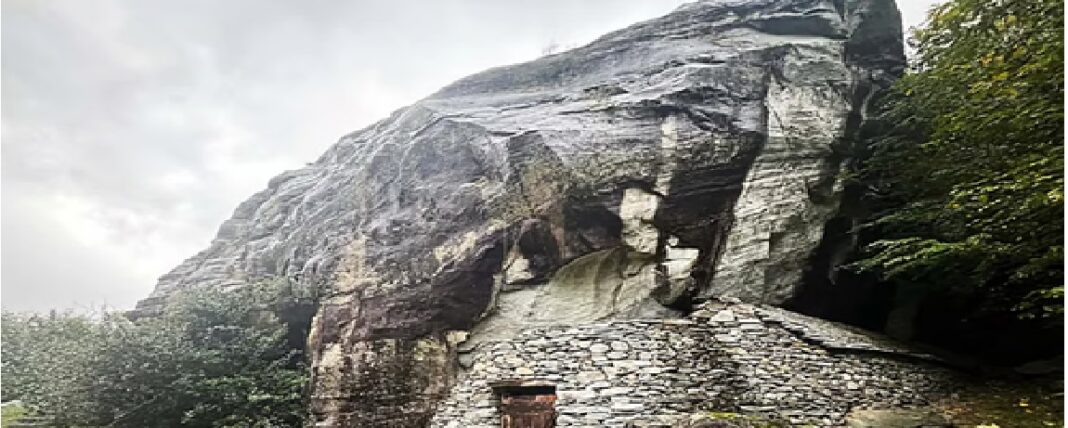

Residents of the Bavona Valley created stone shelters by making use of massive rocks and boulders that had fallen naturally. Photo: Mike MacEacheran
The mention of Switzerland often conjures images of the snow-capped Alps or picturesque Alpine villages. Yet, in the southern canton of Ticino, there lies a valley—the Bavona Valley—where, for centuries, people lived in cave-like dwellings beneath massive boulders. Spanning 12.1 kilometers in length but only a few hundred meters in width, this rugged terrain presented a formidable environment; here, inhabitants managed to survive by utilizing the colossal rocks scattered across the treacherous Alpine landscape. Today, this valley—prone to floods and landslides—is home to only 11 permanent residents.
The valley’s primary attraction lies in its ancient stone shelters, known locally as “splüi.” These dwellings were created by utilizing the natural cavities beneath massive boulders that had fallen from the mountainside. Small stone fragments were used to construct walls at the front, fitted with wooden doors. Over four hundred such *splüi* have been identified in and around the Bavona Valley, with the oldest dating back to the Middle Ages. Some served as storage for cheese and wine, others housed bread-making ovens or looms, and some even functioned as traps for wolves. Due to a scarcity of arable land, people would occasionally place soil atop large boulders to cultivate vegetable gardens. Later, as permanent settlement took hold, residents built two-story stone houses called “rustici,” repurposing the stone shelters as storage units or workspaces.
Beyond these stone shelters, the modern lifestyle of the Bavona Valley’s inhabitants is equally remarkable. In the 1950s, when hydroelectric power plants were being developed across Switzerland, residents in 11 of the valley’s 12 hamlets voted against connecting to the national power grid. Consequently, with the exception of San Carlo, these hamlets remain entirely without electricity. While some residents began using limited solar power for refrigeration and gas for cooking in the 1980s, they still rely on wood-burning stoves to heat their homes.
For those who prefer solitude away from the noise and bustle, the Bavona Valley is an exceptional destination. Located 35 kilometers from Lake Maggiore, this gorge is accessible from Zurich via train and bus. The best way to explore the valley is by following the 13.8-kilometer “Transhumance Trail.” The term “transhumance” refers to the ancient pastoral tradition of moving livestock to mountain pastures in response to the changing seasons. By walking along these historic paths once used by herders, visitors can discover the stone shelters in places like Mondada or Foroglio. Since shops are closed during the off-season, tourists can spend the night in electricity-free Rustisi—bringing their own food—and experience a sense of primitive, undisturbed solitude, far removed from modernity.