



Pakistani astronaut Zeeshan Ali. Photo: Reuters
China’s spacecraft, ‘Shenzhou-24’, launched this Wednesday morning, bound for the country’s own space station, ‘Tiangong’. The spacecraft is being carried by a ‘Long March-2F’ rocket and is crewed by three astronauts. Two of them are Chinese nationals—Tang Hongbo and Wu Yi—while the third is a Pakistani astronaut, Zeeshan Ali.
With the inclusion of Zeeshan Ali, China is sending a foreign national into space for the first time. He will spend 5 to 10 days aboard China’s space station, conducting various scientific experiments. In preparation for this mission, Zeeshan underwent seven months of specialized training in Beijing. He remarked, “I am not just going for myself; I am carrying the name of all of Pakistan on my shoulders.”
But why is China sending a Pakistani astronaut into space? According to Laura Bicker, the BBC’s China correspondent, there are two primary reasons for China’s decision to send a foreign national into space: science and diplomacy. Beijing hopes that this space mission will further strengthen its relationship with Islamabad.
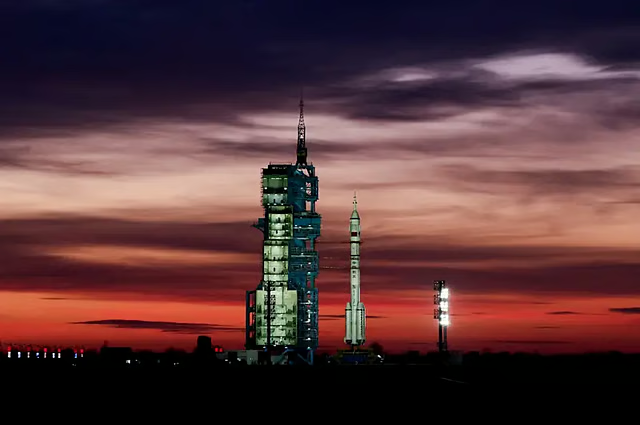
China’s ‘Shenzhou-24’ spacecraft before launch. Photo: Reuters
This mission is being conducted at a time that marks the 75th anniversary of cooperation between China and Pakistan in space research. Laura Bicker notes that China wants to demonstrate to the world that its space station is not merely a facility of its own, but also has the potential to serve as a platform for international research. International partnerships help enhance a nation’s influence and credibility.
Currently, there are only two space stations in Earth’s orbit. One is the International Space Station (ISS), led by the U.S. space agency NASA, with participation from Russia, Japan, Canada, and several European nations. The other is ‘Tiangong’—a space station built using China’s own technology—which has been fully operational since 2022.
According to analysts, NASA’s International Space Station is set to be retired by 2030. Consequently, China’s influence in space science is growing. Beijing is also seeking to establish itself as an alternative to U.S.-led space programs. Furthermore, China has set a goal to land its astronauts on the Moon for the first time by 2030.
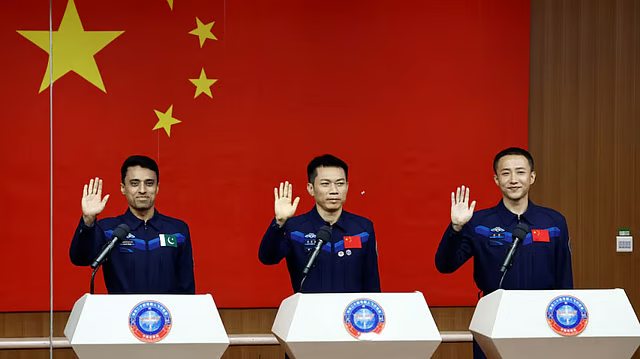
Pakistani astronaut Muhammad Zeeshan Ali (left) with Chinese astronauts Tang Hongbo and Wu Yi. Photo: Reuters
Pakistan’s participation in China’s space mission is a significant development, as the country does not possess its own spacecraft and must therefore rely on China for such research. To date, citizens from 50 countries have traveled to space; however, only the United States, China, and Russia have demonstrated the capability to send humans into space using spacecraft of their own manufacture.
In a press conference held before his departure for space today, Zishan Ali said, “To all the children who will be looking up at me while I am in orbit around the Earth—look toward the sky, and remember that I am up there carrying your dreams with me.”