

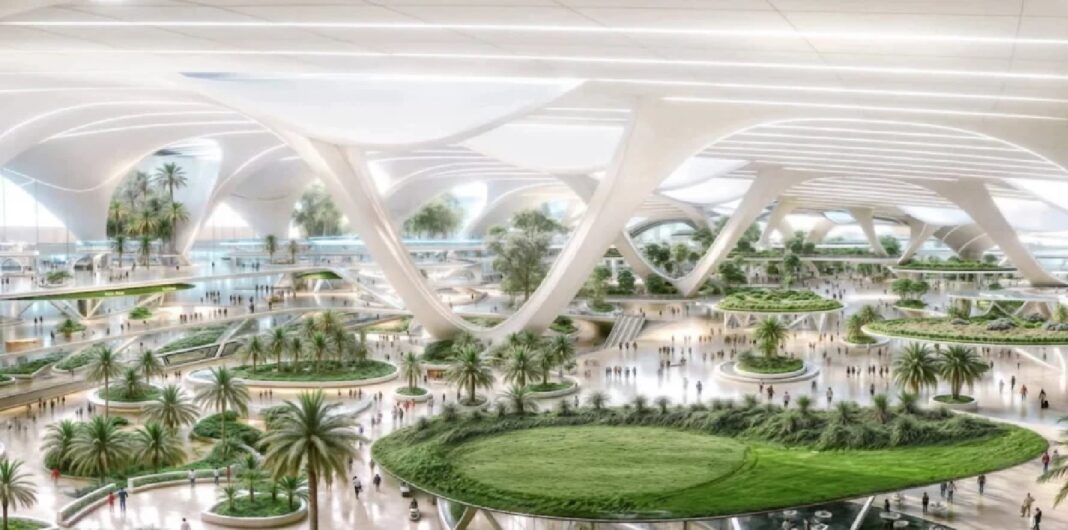

Dubai Airport. Photo: Collected
Dubai is planning to build some of the key infrastructure of its new airport underground to protect it from future drone or missile attacks in the wake of the Iran war, but authorities say the multi-billion dollar airport expansion plan will not be slowed down by the war.
In an interview with the British newspaper Financial Times, Dubai Airports CEO Paul Griffiths said that critical infrastructure at the new airport, such as fuel storage tanks, could be placed underground. In addition, some facilities are being considered to be reinforced to withstand possible attacks.
“Some infrastructure may need to be strengthened against potential future attacks to make them more resilient,” Griffiths said.
He said plans to make the airport more resilient, including underground storage of fuel, are currently being considered in the design process. The likelihood of an attack, its consequences and the overall risk are all being taken into account.
Dubai’s new airport will be able to handle 250 million passengers a year. Griffiths said the war would not reduce the scope of the multi-billion dollar project.
He said that after the conflict between Iran, the United States and Israel broke out, he had a brief discussion with Chairman Sheikh Ahmed bin Saeed Al Maktoum about long-term strategy. It was decided that this war would not change their long-term strategy.
Dubai International Airport, which opened in 1960, was once the world’s largest international airport for a decade. However, it fell out of the world’s top five international airports in the first half of this year when tensions between Iran, the United States and Israel caused widespread unrest in the Middle East.
During the height of the fighting, Dubai’s main airport, DXB, was hit by an above-ground fuel tank, forcing the airport to temporarily close. However, Griffiths said the airport was reopened within an hour of the attack and remained operational throughout.
Dubai’s main airline, Emirates, grounded its entire fleet after the war began. It resumed flights within days, using narrow airspace controlled by the UAE military.
In the first few weeks of the conflict, areas of Dubai, including the area around the airport, were targeted by drones and ballistic missiles. Hundreds of people were injured and more than a dozen were killed in the conflict in the United Arab Emirates.
Griffiths said that through immediate communication with the UAE authorities and military, the airport authorities would have received advance warning of the attack, which would have allowed passengers to be evacuated to safe underground areas in a short time.
According to him, out of a total of 111 warnings, 17 attacks occurred. However, the impact of most of the attacks was very minor. After an attack, when the civil defense forces and military authorities declared the situation normal, normal airport operations were quickly resumed. Sometimes, the situation returned to normal within just 10 minutes of the warning being issued, he said.
Passenger numbers at Dubai Airport fell by almost a third in the first half of this year. In February, the number of passengers travelling through the airport was 7.4 million. In March, it fell to 2.5 million. Then it rose to 3.5 million in April, 4.5 million in May, 5 million in June and 6.3 million in July.
Griffiths said passenger numbers are now growing again and he expects Dubai to regain its status as the world’s busiest international airport next year.
“People’s memories fade quickly now and we have stabilized the situation. We expect a full recovery early next year,” he said.
According to him, more than 50 airlines have already started flights to Dubai. Among them is Air France. British Airways will also resume flights to Dubai when its winter schedule starts in October.
However, Griffiths said that some airlines are taking time to return to flights to the Middle East as the newly used aircraft for passenger transport between Europe and Asia are at full capacity.
“78 percent of our passengers have returned to DXB. The remaining 22 percent will also return very soon,” he said.
Source: Financial Times